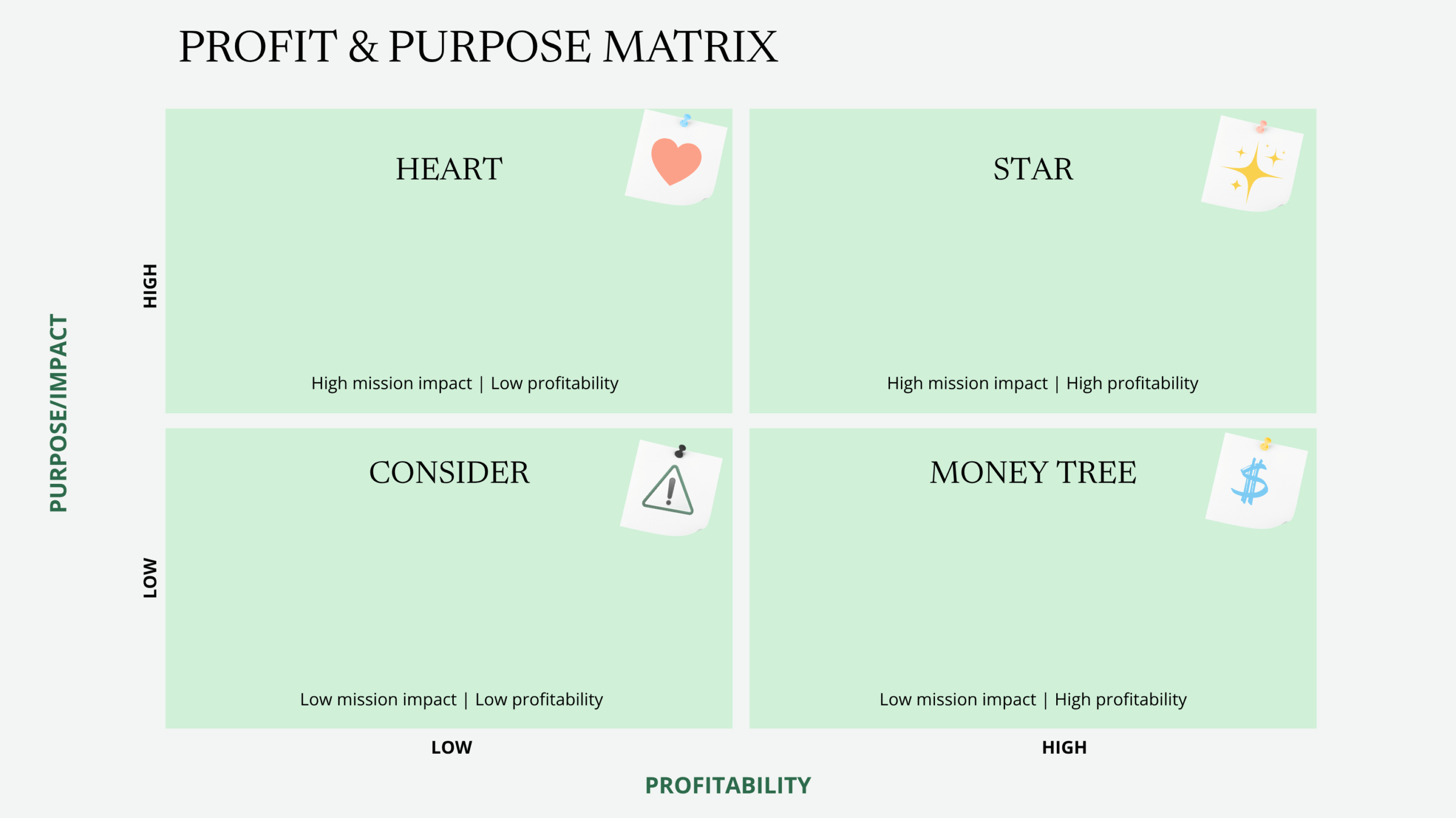
The Stakeholder Profit & Purpose Matrix helps social entrepreneurs and advisors to understand how different stakeholders influence the enterprise. “Purpose/Impact” refers to the positive effect a stakeholder has on the enterprise’s mission, development or community goals. “Profitability” refers to the value the relationship brings in terms of resources, support, opportunities or stability.
The tool makes it easier to prioritise which relationships to invest in, maintain, develop or reconsider.
How to Use the Matrix for Stakeholder Analysis
Step 1 — Identify stakeholders
Create a list of all stakeholders relevant to the enterprise: customers, partners, funders, suppliers, volunteers, public agencies, networks, community groups, municipalities/regions and cross-border actors
Step 2 — Assess each stakeholder from two angles
A. Mission Impact (Purpose/Impact)
How much does each stakeholder contribute to your ability to fulfil your mission? Consider:
- alignment with your social purpose
- support to your target groups
- ability to strengthen community impact
- contribution to long-term sustainability
Rate as low / medium / high
B. Value to the Enterprise (Profitability)
This does not mean financial profit. It means:
- access to resources
- opportunities
- knowledge
- networks
- legitimacy
- visibility
Rate as low / medium / high
Step 3 — Place stakeholders in the matrix
You can download and print the PDF of the profit and purpose matrix
1. ⭐ Star — High mission impact, High value
“Invest and grow the relationship”
These stakeholders strengthen both your mission and your organisational capacity. Examples: a strong municipal partner, a funder aligned with your values, an anchor business.
Action: Deepen collaboration, co-create, invite into long-term planning.
2. ❤️ Heart — High mission impact, Low value
“Keep but support the relationship more effectively” . These stakeholders contribute strongly to your mission but require more resources than they provide. Examples: vulnerable user groups, a local initiative with great social value but limited capacity.
Action: Protect the relationship, but explore support, structure or clearer boundaries.
3. 💰 Money Tree — Low mission impact, High value
“Maintain and increase mission alignment”. These actors contribute resources, stability or opportunities but are not central to your mission. Examples: a financially strong partner with low social focus, a commercial supplier.
Action: Keep the relationship and explore ways to connect them more to your purpose.
4. ❓ Consider — Low mission impact, Low value
“Re-evaluate why this relationship exists”. These stakeholders neither strengthen your mission nor provide significant value.
Action: Consider reducing involvement, restructuring the relationship or letting it fade out.
Step 4 — Reflect and prioritise
Discuss:
- Which relationships are strategic for the next 12 months?
- Which requires nurturing?
- Which can be reshaped?
- Where do we see untapped potential?
- Where do we overinvest time?
Step 5 — Define relationship actions
For each stakeholder, choose one: Invest – Support – Align – Reconsider
This becomes the basis for the entrepreneur’s networking strategy.
You can also download and print the PDF of the profit and purpose matrix