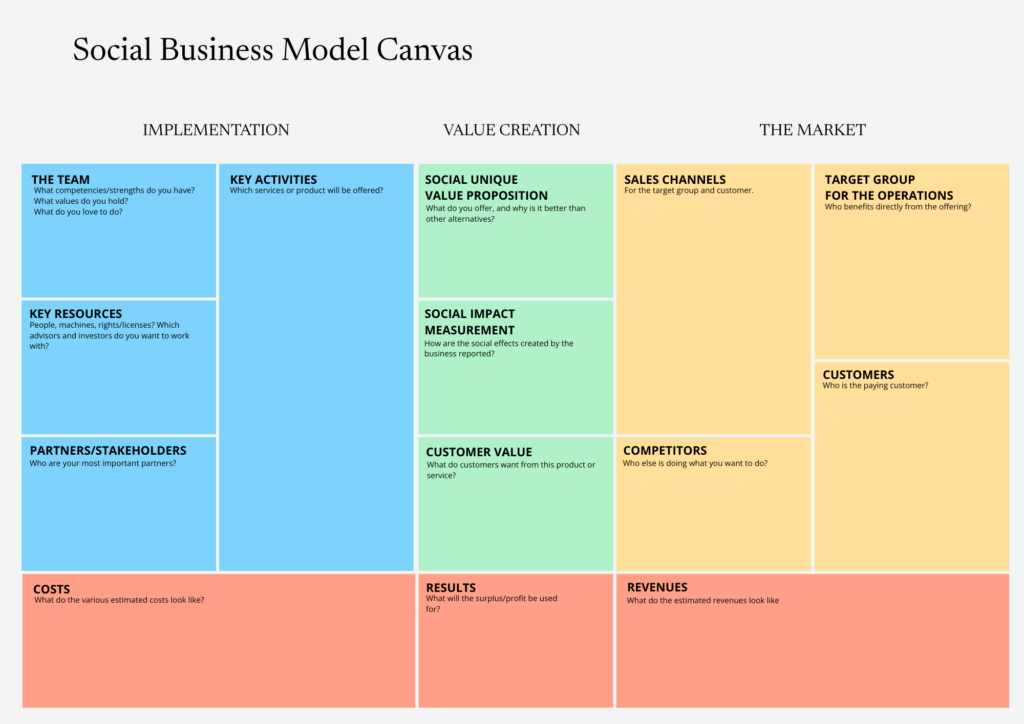
Using Canvas is a good way to get an overview of your business model. In this section you will find different models of Business Model Canvas suitable for social entrepreneurs.
Business models for rural social enterprises
Rural areas often face interconnected challenges such as population decline, ageing populations, remoteness, and limited access to services, jobs, and economic opportunities. Traditional businesses struggle to operate in these contexts, while reductions in public services further widen gaps in service provision and employment.
Social entrepreneurship is increasingly seen as a way to address these issues. By combining economic activities with social goals, social enterprises can create jobs, provide essential services, and strengthen local communities. Their strong local embeddedness enables them to respond effectively to rural needs.
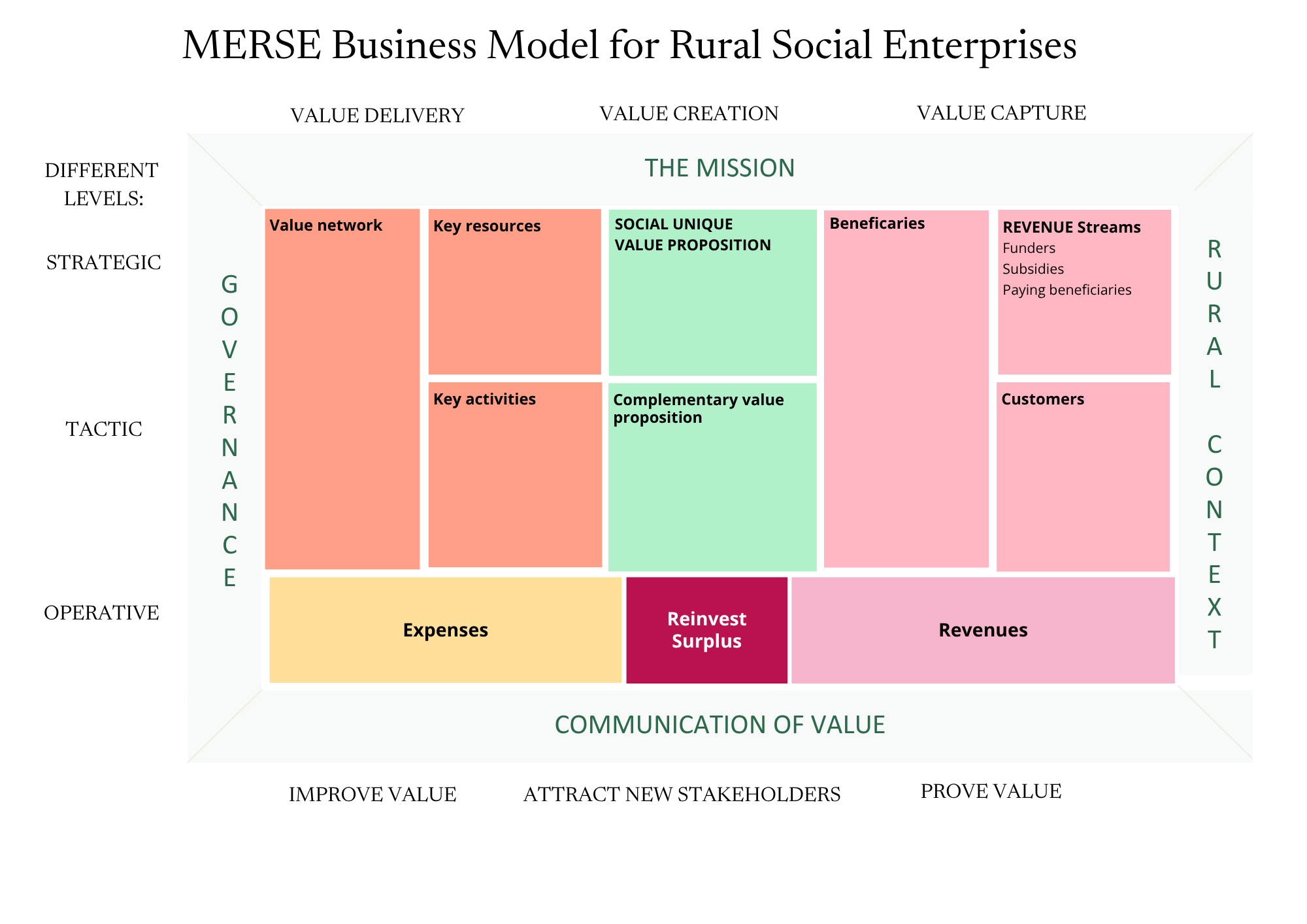
However, social enterprises also face barriers, including limited access to financing, markets, and long-term sustainability. Adapted business models that balance social impact with financial viability remain a key challenge. The MERSE project has developed a business model framework tailored to social enterprises in rural areas, with the aim of helping small social enterprises better identify key components in their business modelling. The business model also outlines the conditions (frames) that both shape and constrain rural social enterprises, as well as strategies for addressing these challenges. Download the Merse Business Model for Rural Social Enterprises (PPT)
Instructions for the MERSE Social Business Model Framework
Illustration of the model:
Social Business Model Canvas
The social business model canvas is another model. The Social Business Canvas is a practical framework that helps advisors work with enterprises whose primary purpose is social and community value. It supports a structured conversation about how mission, resources, revenue streams and intended outcomes align.
For social enterprises in rural areas, the canvas also helps articulate the relationship between the organisation and its local context, including the community’s needs, assets and long-term development goals. Unlike traditional business tools, this canvas highlights how values, participation and social purpose drive the organisational model. Business advisors can use it to guide strategic planning, clarify roles and expectations, and strengthen the connection between social value creation and financial sustainability.
It is especially useful in early-stage advisory processes, but also in later phases when enterprises refine their direction or prepare for strategic decisions. The canvas encourages an integrated view of the enterprise: not only what it does but why it does it, who benefits, what capacities are required, and how outcomes are demonstrated. This helps advisors frame conversations that lead to robust, mission-driven business models suited for rural conditions
You can download and print the PDF with the Social business model canvas. Or you can download and fill out the PowerPoint file or the fillable PDF.
Illustration of the Social Business Model Canvas